Yue Lin

Ph.D. Student at CUHK-Shenzhen Multi-Agent Learning & Game Theory

The powerful play goes on, and you may contribute a verse.

Hi, this is Yue Lin (/ˈjuːeɪ lɪn/, or 林越 in Chinese), and welcome to my personal website. Currently I am a Ph.D. student (data science program) in the School of Data Science at The Chinese University of Hong Kong, Shenzhen, fortunately advised by Prof. Baoxiang Wang and Prof. Hongyuan Zha. Other close collaborators include Prof. Wenhao Li and Prof. Pascal Poupart. For a printable summary of my background, see my [Resume].

  • My research interests lie primarily in designing efficient learning algorithms to guide agents toward better equilibria in multi-agent tasks. For experts: (1) solving sequential social dilemmas, by designing learning algorithms that incorporate mechanism design, and (2) designing learning methods for mechanism design problems.
  • Most of my focus is on sequential mixed-motive multi-agent scenarios, and I am particularly interested in communication mechanisms (keywords: information design, Bayesian persuasion, cheap talk, reputation), as well as some other mechanisms that influence others, such as incentivization.
  • My expertise in learning methods lies in reinforcement learning (RL) and large language models (LLMs).
And how could one endure being a man, if not also for the possibility to create, guess riddles, and redeem accidents? To redeem those who lived in the past and to recreate all "it was" into "thus I willed it" — that alone should I call redemption.
— Friedrich Nietzsche, Thus Spoke Zarathustra.

Research Interests

Currently

  • Multi-Agent Reinforcement Learning
  • Game Theory: Information Design
  • LLMs for Game Solvers
  • Communication Mechanisms

Formerly

  • Redundant Manipulator Control
  • Robotic Mechanism Design

Education & Experience

Education

  • The Chinese University of Hong Kong, Shenzhen
    Ph.D. Student in Data Science @ School of Data Science (2024.8 - Present)
    Advisors: Prof. Baoxiang Wang & Prof. Hongyuan Zha
  • Tianjin Polytechnic University
    Bachelor of Engineering in Computer Science and Technology (2018.9 - 2022.6)
    • School of Computer Science and Technology (2019.9 - 2022.6)

      GPA: 3.89 / 4 (92.22 / 100); Rank: 1 / 127
      [Certificate]

    • School of Mechanical Engineering (2018.9 - 2019.6)

      GPA: 3.90 / 4 (92.00 / 100); Rank: 1 / 60

Experience

  • Microsoft
    Research Intern @ Microsoft Research Asia (MSRA) (2026.8 - Present)
    Group: Data, Knowledge and Intelligence
    Mentor: Lu Wang
  • Tencent
    Research Intern @ Lightspeed Studios, Shenzhen (2025.12 - 2026.6)
    Group: Interactive Entertainment Group (IEG)
    Team: Omni
    Mentor: Yuan Liu
  • The Chinese University of Hong Kong, Shenzhen
    Research Assistant @ School of Data Science (2022.2 - 2024.8)
    Advisors: Prof. Baoxiang Wang & Prof. Hongyuan Zha (Subsequently my Ph.D. Supervisor and Co-Supervisor)

Publications & Manuscripts

Type
Authorship
Count 9

2026

  • The Reciprocity Gradient.
    Yue Lin, Pascal Poupart, Shuhui Zhu, Dan Qiao, Wenhao Li, Yuan Liu, Hongyuan Zha, Baoxiang Wang.
    Advances in Neural Information Processing Systems (NeurIPS). 2026. Poster.

    Highlight: This is one of my representative works.

    Resources: [arXiv]

    Review scores: 6/5/4 (out of 6; 4 = borderline accept).

    Category: Data Science × Game Theory × Social Science

    TLDR: Derives a pure-RL reciprocity gradient that solves cross-agent influence attribution by differentiating future returns through chains of actions, evaluations, and other agents' responses, so an agent learns from scratch both how to behave under social scrutiny and how to influence reputations across the group and shift its broader social climate without reward shaping, centralized mechanisms, or reputation priors.

    [Expand Abstract]
    Communication is fundamental to sustaining reciprocity and cooperation in strategic interactions. We identify and formulate the influence attribution problem as the central optimization difficulty inherent in such dynamics for a learning agent: any action or signal the agent emits reshapes the reputations of many third parties along combinatorially branching paths before feeding back into its own future rewards, forcing the agent to account for all of these indirect channels at once when choosing every action. To address this, we introduce the reciprocity gradient, which explicitly backpropagates reward gradients through private estimators of opponents' policies trained from public observations. The gradient flows through the reputation chain itself analytically, rather than being estimated from sampled returns. It jointly optimizes actions and evaluative signals without intrinsic rewards or reward shaping. Empirically, the method recovers near-optimal context-sensitive policies, while sample-based baselines collapse into constant-output policies.
    [Expand BibTeX]
    @inproceedings{lin2026reciprocity,
      title={The Reciprocity Gradient},
      author={Lin, Yue and Poupart, Pascal and Zhu, Shuhui and Qiao, Dan and Li, Wenhao and Liu, Yuan and Zha, Hongyuan and Wang, Baoxiang},
      booktitle={Advances in Neural Information Processing Systems},
      year={2026},
      url={https://arxiv.org/abs/2605.08323}
    }
    [Expand Afterword]

    NeurIPS 2026

    世界偶尔回应我

    “你不能只为自己而活;千万条丝线将你与你的同胞连接在一起,而沿着那些丝线,如同沿着共振的弦一般,你的行为会作为原因向外传递,又将造成结果返回到你自己身上。”

    —— 《参与他人的罪恶》

    这篇文章研究声誉(Reputation)问题,是一个多人通信问题,每个人可以评价别人的行为,每个人在和另一个人互动的时候也都可以看到别人对它的评价。方法是纯RL,我们的方法可以让一个从0开始学习的 Agent 学会如何在一个社会评价体系里存活(在他人的凝视下behave itself),并学会如何通过闲谈评价别人的行为来改变整个社会风气使其对自己有利。潜在的未来应用场景包括涉及通信的社会群体系统的建模,比如电商平台和数字零工系统(如网约车平台)里面的评论系统。

    这个问题的难点在于延迟奖励和信号影响力的归因。当每个人的行为都会被别人评价的时候,玩家在做任何动作时都要考虑自己对他人的影响 以及这个影响以后又将会如何影响回自己。个体A该如何行动 来改变B的看法 从而使C在之前从没见过A的情况下愿意和A自己合作?A又该如何评价别人的行为 来操纵整个群体的声誉 从而使自己以后可以获得更多收益?“众生随业流转。” 我们希望设计算法捕捉到这种交互过程中的错综复杂的 业力 Karma,从而稳定地优化收益期望。我们把这种跨Agent 的 Credit Assignment 问题称为 Influence Attribution,即,研究玩家该如何完成这一条链的归因:如何提高自己的收益 -> 谁的行为影响了我的收益 -> 如何改变自己的动作来改变那些人对我的评价/如何改变自己对别人的评价来改变群体的风气使其对我有利。

    没有 Reward Shaping,没有 Centralized Mechanisms,没有在方法里引入任何关于 Reputation 的先验知识,我们给出的答案是简单自然的,自然到能让人感觉这问题本就应该这样解决:梯度。把动作也看成是一种信号,那么我的信号的细微变化会引起你的行为的什么变动这个问题,就被归约成咱的老问题 通信问题了,直观上可以说动作也是在表达你的倾向所以也是通信。在这个环境的随机过程里,我们重新推导了 Policy Gradient,计算每个 sampled trajectory 里的自己最后的收益期望对自己策略的梯度,中间沿着整个计算图 chain through 了的所有的策略函数,也就是沿着这整个互动历史构成的网络拓扑来计算了“个体的行为对自己未来收益的途径过程中的每个人造成的影响”,可以说Influence Attribution 是自动完成的。实验效果是在经典Leading Eights和新造的群体里都达到了理论上的最优均衡。

    不是花费最多心血的一篇但算是很有纪念意义的一篇了,这是当时吸引我加入这个研究方向的问题之一。组里之前做过一些尝试但是探索比较曲折所以一直被搁置。一直以来有隐隐感觉这个问题也许可以用之前的一些简单的insights来搞,不过一直没有真的去起步。在经历诸多其他稿子的不顺(有不可抗力也有自身原因)之后,终于在今年2月底决定捡起来开始着手推进。折腾了2个月做了尽可能足的准备,直接投直接中,稳得像失去过什么。在这个技术日新月异的大模型时代,做出一篇古典的强化学习算法已经不算是什么能称道的事了,但这篇解决了不光是一个问题也解决了心结,作为又一个个人阶段性的工作我仍然感到很满意,也是感性地写了这许多。于是今晚可以不再琢磨 multi-agent system 的春天到底什么时候来,喃喃着什么 “一切烦恼都来自于人际关系”、“以特定方式把 agents 组织成社会才会产生真正的智能”、”more is different” 就睡着了

    感谢导师们的指导,感谢合作者及身边人的支持。孩子终于又要到饭了🍌🐒

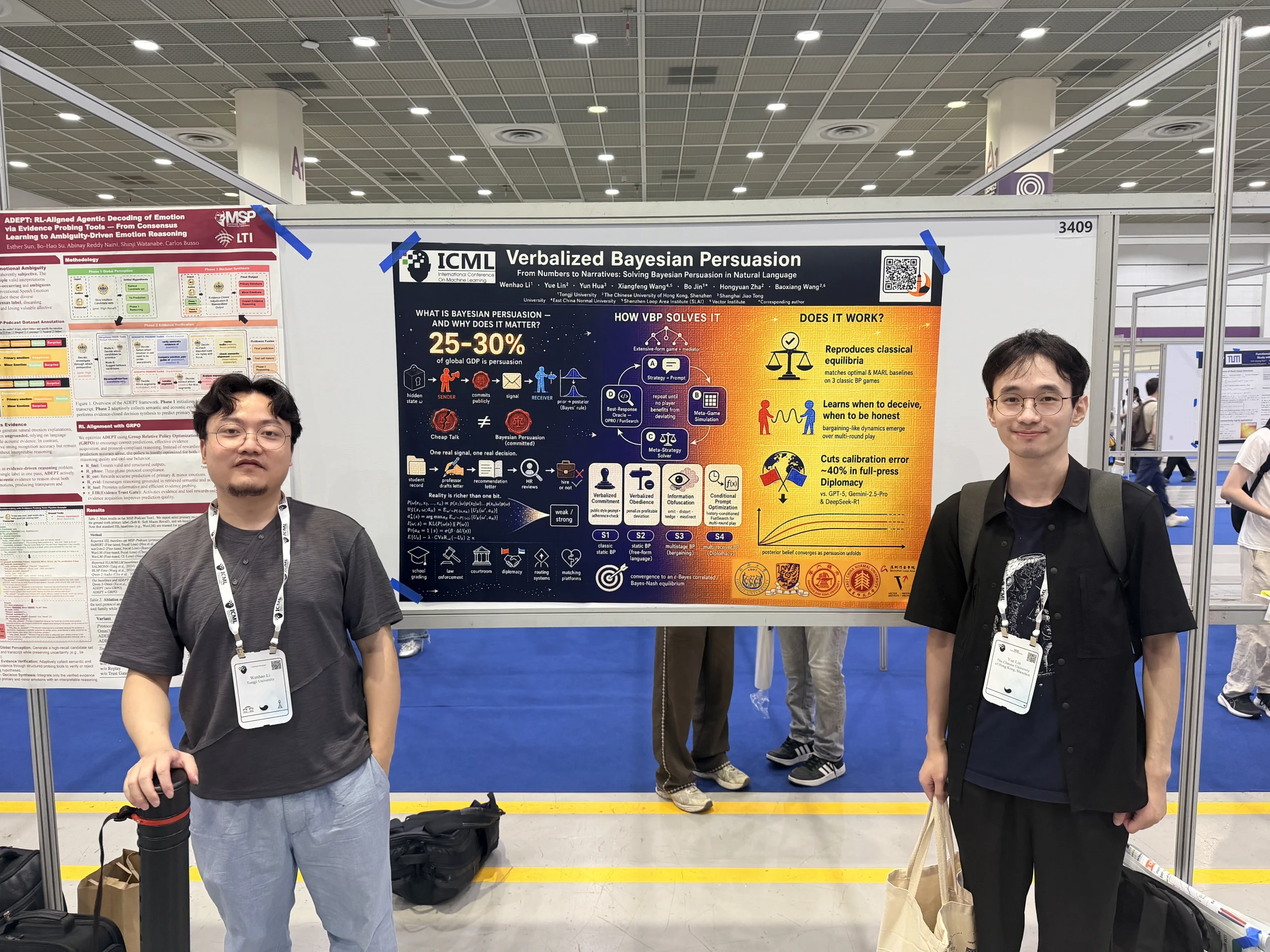
  • Verbalized Bayesian Persuasion.
    Wenhao Li, Yue Lin, Yun Hua, Xiangfeng Wang, Bo Jin, Hongyuan Zha, Baoxiang Wang.
    International Conference on Machine Learning (ICML). 2026. Poster.

    Resources: [Paper] [arXiv]

    Category: Data Science × Game Theory

    TLDR: Introduces a verbalized Bayesian-persuasion framework in which LLMs play sender and receiver while an equilibrium solver searches for natural-language messages the receiver has reason to follow, including in multi-stage dialogues.

    [Expand Abstract]
    Information design (ID) explores how a sender influence the optimal behavior of receivers to achieve specific objectives. While ID originates from everyday human communication, existing game-theoretic and learning methods often model information structures as numbers, which limits many applications to toy games. This work leverages LLMs and proposes a verbalized framework in Bayesian persuasion (BP), which extends classic BP to real-world games involving human dialogues for the first time. We map the BP to a verbalized mediator-augmented game, where LLMs instantiate the sender and receiver. To efficiently solve the verbalized game, we propose a generalized equilibrium-finding algorithm combining LLM and game solver. The algorithm is reinforced with techniques including verbalized commitment assumptions, verbalized obedience constraints, and information obfuscation. Experiments in dialogue scenarios, such as recommendation letters, law enforcement, diplomacy with press, validate that our framework can reproduce theoretical results in classic BP and discover effective persuasion strategies in more complex natural language and multi-stage scenarios.
    [Expand BibTeX]
    @inproceedings{li2026verbalized,
      title={Verbalized Bayesian Persuasion},
      author={Li, Wenhao and Lin, Yue and Hua, Yun and Wang, Xiangfeng and Jin, Bo and Zha, Hongyuan and Wang, Baoxiang},
      booktitle={Proceedings of the 43rd International Conference on Machine Learning},
      series={Proceedings of Machine Learning Research},
      volume={306},
      publisher={PMLR},
      year={2026},
      url={https://openreview.net/forum?id=dc0WdvWSnB}
    }
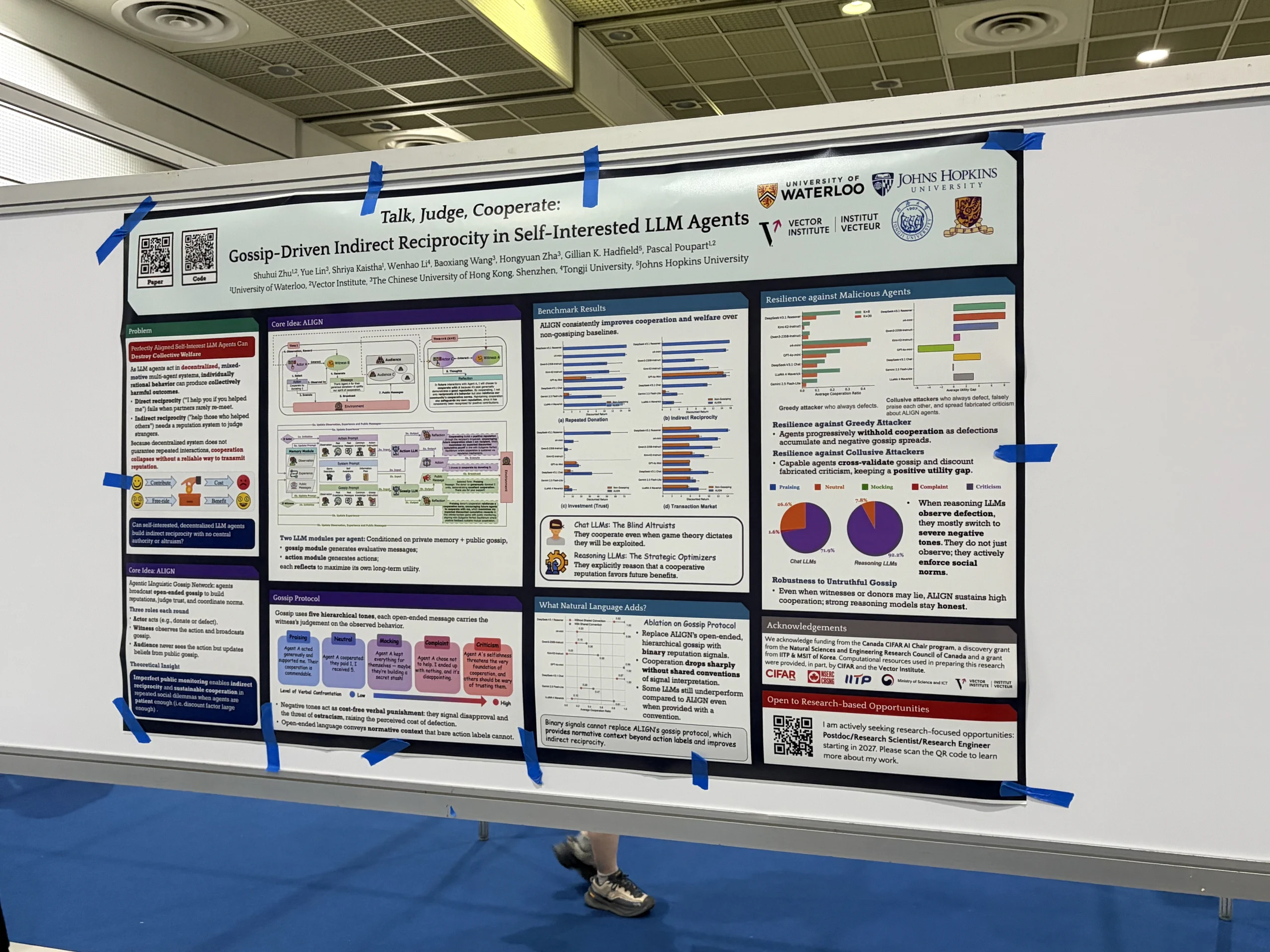
  • Talk, Judge, Cooperate: Gossip-Driven Indirect Reciprocity in Self-Interested LLM Agents.
    Shuhui Zhu, Yue Lin, Shriya Kaistha, Wenhao Li, Baoxiang Wang, Hongyuan Zha, Gillian K. Hadfield, Pascal Poupart.
    International Conference on Machine Learning (ICML). 2026. Poster.

    Resources: [Paper] [arXiv] [Code]

    Category: Data Science × Game Theory × Social Science

    TLDR: Introduces ALIGN, a decentralized mechanism in which self-interested language-model agents exchange open-ended, tone-graded gossip to build reputations, coordinate social norms, and isolate defectors.

    [Expand Abstract]
    Indirect reciprocity, which means helping those who have helped others, is difficult to sustain among decentralized, self-interested LLM agents without reliable reputation systems. We address this challenge with the Agentic Linguistic Gossip Network (ALIGN), an automated framework that enables decentralized agents to form reputations, evaluate trustworthiness, and coordinate social norms by strategically sharing open-ended gossip with hierarchical tones. We demonstrate that ALIGN consistently improves indirect reciprocity and resists malicious entrants by identifying and ostracizing defectors. Notably, we find that stronger reasoning capabilities in LLMs lead to more incentive-aligned cooperation, whereas chat models often over-cooperate even when strategically suboptimal. These results suggest that leveraging LLM reasoning through decentralized gossip is a promising path for maintaining social welfare in agentic ecosystems. Our code is available at https://github.com/shuhui-zhu/ALIGN.
    [Expand BibTeX]
    @inproceedings{zhu2026talk,
      title={Talk, Judge, Cooperate: Gossip-Driven Indirect Reciprocity in Self-Interested {LLM} Agents},
      author={Zhu, Shuhui and Lin, Yue and Kaistha, Shriya and Li, Wenhao and Wang, Baoxiang and Zha, Hongyuan and Hadfield, Gillian K. and Poupart, Pascal},
      booktitle={Proceedings of the 43rd International Conference on Machine Learning},
      series={Proceedings of Machine Learning Research},
      volume={306},
      publisher={PMLR},
      year={2026},
      url={https://openreview.net/forum?id=jYxRNCfRaD}
    }

2025

  • Policy-Conditioned Policies for Multi-Agent Task Solving.
    Yue Lin, Shuhui Zhu, Wenhao Li, Ang Li, Dan Qiao, Pascal Poupart, Hongyuan Zha, Baoxiang Wang.
    arXiv preprint. 2025-12-24.

    Resources: [Manuscript]

    Category: Data Science × Game Theory

    TLDR: Represents each agent's strategy as readable source code and introduces Programmatic Iterated Best Response, where an LLM rewrites one policy against another using game rewards and unit tests as feedback.

    Note: This work was scooped by Evaluating LLMs in Open-Source Games. We then planned a substantially improved version, but that follow-up direction was also scooped by Google DeepMind's Code-Space Response Oracles: Generating Interpretable Multi-Agent Policies with Large Language Models.

    [Expand Abstract]
    In multi-agent tasks, the central challenge lies in the dynamic adaptation of strategies. However, directly conditioning on opponents' strategies is intractable in the prevalent deep reinforcement learning paradigm due to a fundamental “representational bottleneck”: neural policies are opaque, high-dimensional parameter vectors that are incomprehensible to other agents. In this work, we propose a paradigm shift that bridges this gap by representing policies as human-interpretable source code and utilizing Large Language Models (LLMs) as approximate interpreters. This programmatic representation allows us to operationalize the game-theoretic concept of Program Equilibrium. We reformulate the learning problem by utilizing LLMs to perform optimization directly in the space of programmatic policies. The LLM functions as a point-wise best-response operator that iteratively synthesizes and refines the ego agent's policy code to respond to the opponent's strategy. We formalize this process as Programmatic Iterated Best Response (PIBR), an algorithm where the policy code is optimized by textual gradients, using structured feedback derived from game utility and runtime unit tests. We demonstrate that this approach effectively solves several standard coordination matrix games and a cooperative Level-Based Foraging environment.
    [Expand BibTeX]
    @misc{lin2025policyconditioned,
      title={Policy-Conditioned Policies for Multi-Agent Task Solving},
      author={Lin, Yue and Zhu, Shuhui and Li, Wenhao and Li, Ang and Qiao, Dan and Poupart, Pascal and Zha, Hongyuan and Wang, Baoxiang},
      year={2025},
      eprint={2512.21024},
      archivePrefix={arXiv},
      primaryClass={cs.GT},
      doi={10.48550/arXiv.2512.21024},
      url={https://arxiv.org/abs/2512.21024}
    }
  • Information Bargaining: Bilateral Commitment in Bayesian Persuasion.
    Yue Lin, Shuhui Zhu, William A Cunningham, Wenhao Li, Pascal Poupart, Hongyuan Zha, Baoxiang Wang.
    Workshop on Information Economics × Large Language Models at the ACM Conference on Economics and Computation (EC). 2025. Poster.

    Resources: [Paper] [Code & Experiments]

    Category: Game Theory

    TLDR: Recasts long-term Bayesian persuasion as two-sided bargaining with commitment on both sides, separating the value of private information from the advantage of proposing first.

    Earlier title: Bayesian Persuasion as a Bargaining Game (used at the EC '25 workshop).

    [Expand Abstract]
    Bayesian persuasion, an extension of cheap-talk communication, involves an informed sender committing to a signaling scheme to influence a receiver’s actions. Compared to cheap talk, this sender’s commitment enables the receiver to verify the incentive compatibility of signals beforehand, facilitating cooperation. While effective in one-shot scenarios, Bayesian persuasion faces computational complexity (NP-hardness) when extended to long-term interactions, where the receiver may adopt dynamic strategies conditional on past outcomes and future expectations. To address this complexity, we introduce the bargaining perspective, which allows: (1) a unified framework and well-structured solution concept for long-term persuasion, with desirable properties such as fairness and Pareto efficiency; (2) a clear distinction between two previously conflated advantages: the sender’s informational advantage and first-proposer advantage. With only modest modifications to the standard setting, this perspective makes explicit the common knowledge of the game structure and grants the receiver comparable commitment capabilities, thereby reinterpreting classic one-sided persuasion as a balanced information bargaining framework. The framework is validated through a two-stage validation-and-inference paradigm: We first demonstrate that GPT-o3 and DeepSeek-R1, out of publicly available LLMs, reliably handle standard tasks; We then apply them to persuasion scenarios to test that the outcomes align with what our information-bargaining framework suggests. All code, results, and terminal logs are publicly available at https://github.com/YueLin301/InformationBargaining.
    [Expand BibTeX]
    @misc{lin2025information,
      title={Information Bargaining: Bilateral Commitment in Bayesian Persuasion},
      author={Lin, Yue and Zhu, Shuhui and Cunningham, William A. and Li, Wenhao and Poupart, Pascal and Zha, Hongyuan and Wang, Baoxiang},
      year={2025},
      note={Poster presented at the First EC Workshop on Information Economics {$\times$} Large Language Models (non-archival)},
      eprint={2506.05876},
      archivePrefix={arXiv},
      primaryClass={cs.GT},
      doi={10.48550/arXiv.2506.05876},
      url={https://arxiv.org/abs/2506.05876}
    }

2024

  • History-Dependent Policy Gradient.
    Yue Lin, Jiacheng Nie, Hongyuan Zha, Baoxiang Wang.
    Draft. 2024.

    Resources: No public manuscript.

    Category: Data Science × Game Theory

    TLDR: Derives an exact policy gradient for non-stationary multi-agent learning systems by explicitly accounting for the histories of the other agents.

    Note: No paper was produced; our method was scooped by Google's paper Multi-agent cooperation through learning-aware policy gradients (ICLR 2025).

    [Expand Abstract]
    No stable abstract is available because this project did not result in a paper.
    [Expand BibTeX]
    @unpublished{lin2024history,
      title={History-Dependent Policy Gradient},
      author={Lin, Yue and Nie, Jiacheng and Zha, Hongyuan and Wang, Baoxiang},
      note={Unpublished project; no manuscript was produced},
      year={2024}
    }

2023

  • Information Design in Multi-Agent Reinforcement Learning.
    Yue Lin, Wenhao Li, Hongyuan Zha, Baoxiang Wang.
    Advances in Neural Information Processing Systems (NeurIPS). 2023. Poster.

    Highlight: This is one of my representative works; as of 2026, my advisor also regards it as one of his representative works.

    Resources: [Paper] [Code] [Experiments] [Blog en] [Blog cn] [Zhihu cn] [Slides] [Talk en] [Talk RLChina] [Patent]

    Category: Data Science × Game Theory

    TLDR: Introduces a Markov signaling game and an obedience-constrained signaling-gradient algorithm that learns what information to reveal over time so self-interested receivers are willing to follow the sender's recommendations.

    [Expand Abstract]
    Reinforcement learning (RL) is inspired by the way human infants and animals learn from the environment. The setting is somewhat idealized because, in actual tasks, other agents in the environment have their own goals and behave adaptively to the ego agent. To thrive in those environments, the agent needs to influence other agents so their actions become more helpful and less harmful. Research in computational economics distills two ways to influence others directly: by providing tangible goods (mechanism design) and by providing information (information design). This work investigates information design problems for a group of RL agents. The main challenges are two-fold. One is the information provided will immediately affect the transition of the agent trajectories, which introduces additional non-stationarity. The other is the information can be ignored, so the sender must provide information that the receiver is willing to respect. We formulate the Markov signaling game, and develop the notions of signaling gradient and the extended obedience constraints that address these challenges. Our algorithm is efficient on various mixed-motive tasks and provides further insights into computational economics. Our code is publicly available at https://github.com/YueLin301/InformationDesignMARL.
    [Expand BibTeX]
    @inproceedings{lin2023information,
      title={Information Design in Multi-Agent Reinforcement Learning},
      author={Lin, Yue and Li, Wenhao and Zha, Hongyuan and Wang, Baoxiang},
      booktitle={Advances in Neural Information Processing Systems},
      volume={36},
      pages={25584--25597},
      year={2023},
      publisher={Curran Associates, Inc.},
      url={https://proceedings.neurips.cc/paper_files/paper/2023/hash/511d7c4e61878cf08ece6351ea3c529e-Abstract-Conference.html}
    }

2022

  • A snake-inspired path planning algorithm based on reinforcement learning and self-motion for hyper-redundant manipulators.
    Yue Lin, Jianming Wang, Xuan Xiao, Ji Qu, Fatao Qin.
    International Journal of Advanced Robotic Systems (IJARS). 2022.

    Resources: [Paper] [Code] [Blog] [Demo Video]

    Category: Robotics

    TLDR: Introduces Swinging Search and Crawling Control, which uses reinforcement learning over the arm's self-motion to find a collision-free target configuration, then moves the arm toward it by crawling instead of searching every intermediate pose.

    [Expand Abstract]
    Redundant manipulators are flexible enough to adapt to complex environments, but their controller is also required to be specific for their extra degrees of freedom. Inspired by the morphology of snakes, we propose a path planning algorithm named Swinging Search and Crawling Control, which allows the snake-like redundant manipulators to explore in complex pipeline environments without collision. The proposed algorithm consists of the Swinging Search and the Crawling Control. In Swinging Search, a collision-free manipulator configuration that of the end-effector in the target point is found by applying reinforcement learning to self-motion, instead of designing joint motion. The self-motion narrows the search space to the null space, and the reinforcement learning makes the algorithm use the information of the environment, instead of blindly searching. Then in Crawling Control, the manipulator is controlled to crawl to the target point like a snake along the collision-free configuration. It only needs to search for a collision-free configuration for the manipulator, instead of searching collision-free configurations throughout the process of path planning. Simulation experiments show that the algorithm can complete path planning tasks of hyper-redundant manipulators in complex environments. The 16 degrees of freedom and 24 degrees of freedom manipulators can achieve 83.3% and 96.7% success rates in the pipe, respectively. In the concentric pipe, the 24 degrees of freedom manipulator has a success rate of 96.1%.
    [Expand BibTeX]
    @article{lin2022snake,
      title={A snake-inspired path planning algorithm based on reinforcement learning and self-motion for hyper-redundant manipulators},
      author={Lin, Yue and Wang, Jianming and Xiao, Xuan and Qu, Ji and Qin, Fatao},
      journal={International Journal of Advanced Robotic Systems},
      volume={19},
      number={4},
      year={2022},
      month=jul,
      publisher={SAGE Publications},
      doi={10.1177/17298806221110022},
      url={https://doi.org/10.1177/17298806221110022}
    }

2021

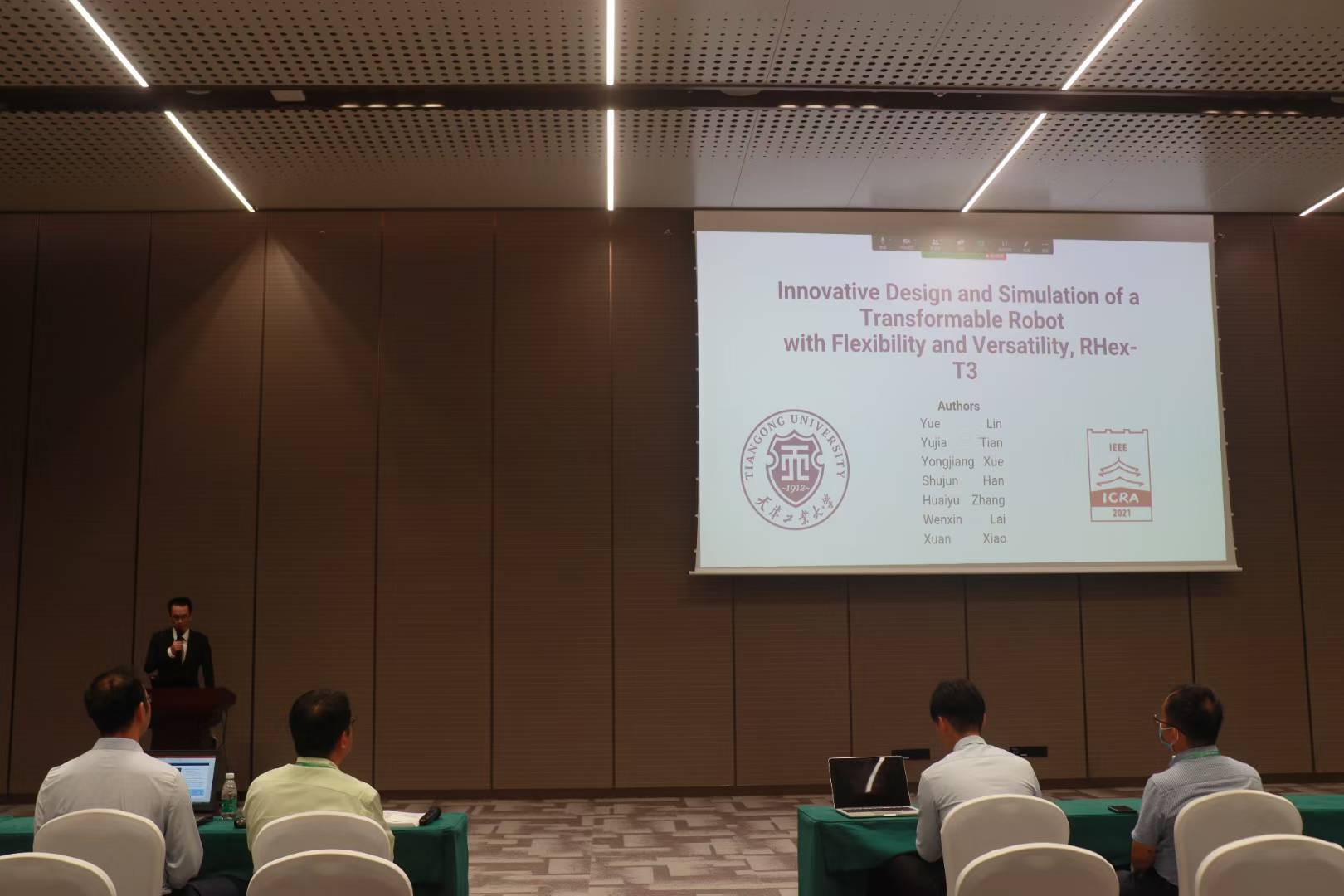
  • Innovative Design and Simulation of a Transformable Robot with Flexibility and Versatility, RHex-T3.
    Yue Lin, Yujia Tian, Yongjiang Xue, Shujun Han, Huaiyu Zhang, Wenxin Lai, Xuan Xiao.
    International Conference on Robotics and Automation (ICRA). 2021. Oral.

    Resources: [Paper] [Blog] [Demo Videos]

    Category: Robotics

    TLDR: Introduces a two-degree-of-freedom transformable RHex design that switches among wheel, leg, claw, and hook modes for efficient travel, obstacle crossing, object transport, and ladder climbing.

    Note: I gave an oral presentation of this work at the conference in Xi’an.

    [Expand Abstract]
    This paper presents a transformable RHex-inspired robot, RHex-T3, with high energy efficiency, excellent flexibility and versatility. By using the innovative 2-DoF transformable structure, RHex-T3 inherits most of RHex’s mobility, and can also switch to other 4 modes for handling various missions. The wheel-mode improves the efficiency of RHex-T3, and the leg-mode helps to generate a smooth locomotion when RHex-T3 is overcoming obstacles. In addition, RHex-T3 can switch to the claw-mode for transportation missions, and even climb ladders by using the hook-mode. The simulation model is conducted based on the mechanical structure, and thus the properties in different modes are verified and analyzed through numerical simulations.
    [Expand BibTeX]
    @inproceedings{lin2021innovative,
      title={Innovative Design and Simulation of a Transformable Robot with Flexibility and Versatility, {RHex-T3}},
      author={Lin, Yue and Tian, Yujia and Xue, Yongjiang and Han, Shujun and Zhang, Huaiyu and Lai, Wenxin and Xiao, Xuan},
      booktitle={2021 IEEE International Conference on Robotics and Automation ({ICRA})},
      pages={6992--6998},
      year={2021},
      month=may,
      publisher={IEEE},
      doi={10.1109/ICRA48506.2021.9561060},
      url={https://doi.org/10.1109/ICRA48506.2021.9561060}
    }

Professional Services

Service Honors

Independent Reviewer

  • NeurIPS 2024 [6; 45615], 2025 [5; 32912], 2026 [4; 17738]
  • ICLR 2025 [3; 21831], 2026 [1; 5994], 2027 [0; 0]
  • ICML 2025 [6; 32893], 2026 [6; 43185]
  • AAAI 2027 [2; 12678]
  • TMLR 2025 [2; 38363], 2026 [2; 10331]

Volunteer

  • ACL 2026 [1; 4155]
  • AAMAS 2024 [3; 9876], 2025 [2; 4792], 2026 [2; 2303]
  • ICML (Position) 2025 [2; 5016]

Format: [assigned manuscripts; review characters]. First “0”: invitation accepted, awaiting assignment; second “0”: assigned, review pending.
Total reviews: —.

Teaching

Teaching Assistant @ The Chinese University of Hong Kong, Shenzhen

  • [MFE5340] Artificial Intelligence in Financial Engineering: Quantitative Investment (2026-27 Term 1).
  • [CSC6021/AIR6001] Artificial Intelligence (2024-25 Term 2).

Patents

  • 基于联邦学习的大语言模型预训练方法和装置
    发明人:李昂、王趵翔、查宏远、林越
    专利权人:香港中文大学(深圳)
    类型:发明
    状态:已授权

    专利号:ZL 2026 1 0720098.0;授权公告号:CN 122242656 B;授权公告日:2026.7.24
    [证书]

  • 多智能体强化学习通信方法、终端设备及存储介质
    发明人:林越、李文浩、查宏远、王趵翔
    申请人:香港中文大学(深圳)
    类型:发明
    状态:已授权

    专利号:ZL 2023 1 0397744.0;授权公告号:CN 116455754 B;授权公告日:2025.9.16
    [证书]

Academic Footprints

  • NeurIPS 2026 @ Sydney, Australia 🇦🇺 (Planning to attend)
  • ICML 2026 @ Seoul, South Korea 🇰🇷
  • ICRA 2021 @ Xi’an, China 🇨🇳

Hobbies

  • Movies
  • DC Comics
    • Recommended reads (ordered by how much I love them):
      • The Riddler: Year One
      • Penguin: Pain & Prejudice
      • Batman: The Killing Joke
      • Batman (2016-): I Am Bane
      • Batman (2016-): The War of Jokes and Riddles
      • One Bad Day: The Riddler

Contact

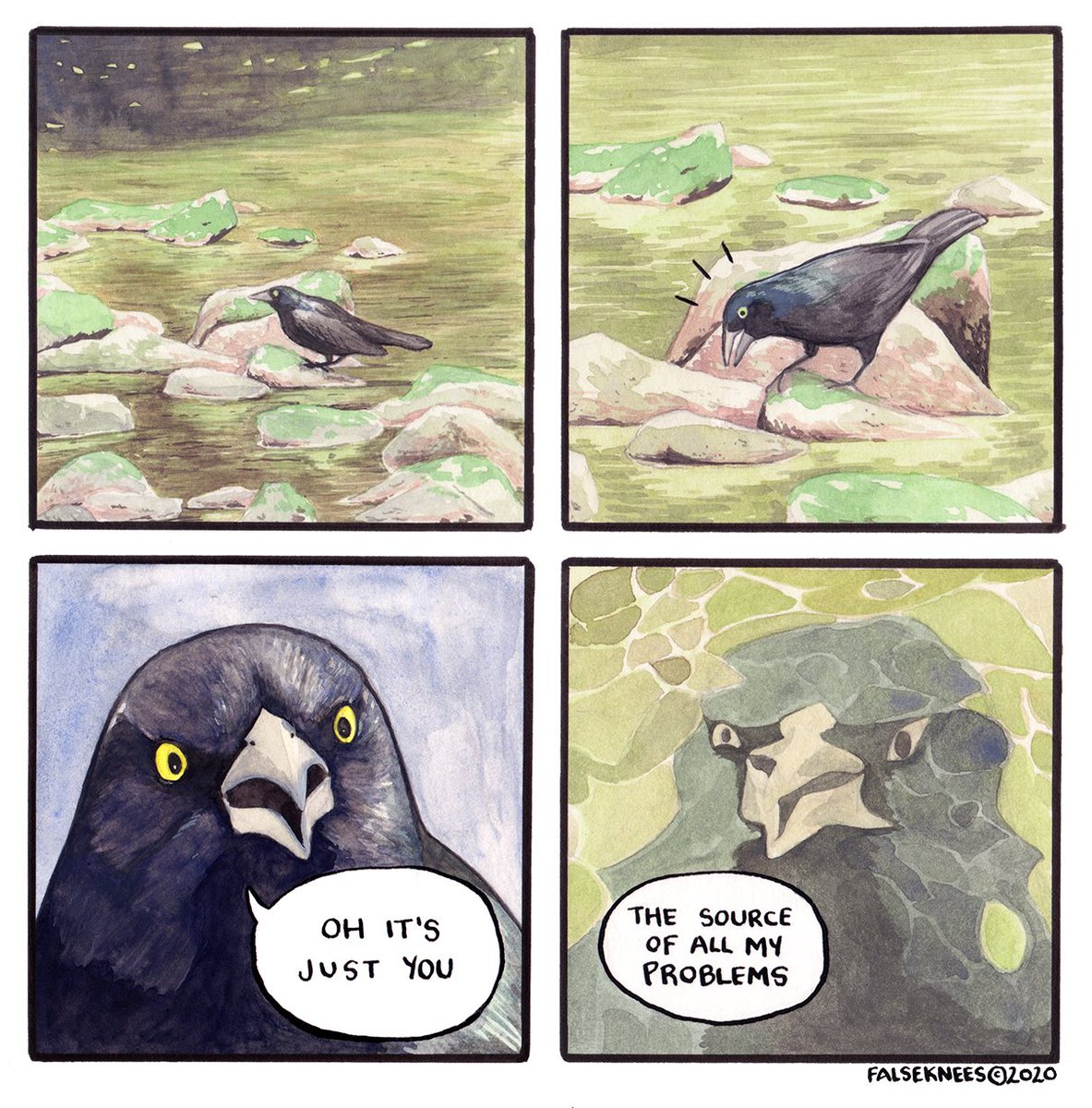
Four-panel False Knees comic about a bird experiencing clarity and autonomy in flight
“False Knees” by Joshua