Talk, Judge, Cooperate: Gossip-Driven Indirect Reciprocity in Self-Interested LLM Agents
本文是对论文的通俗导读,由 Claude Code 生成,作者审校。
TL;DR
- What: A fully decentralized framework where self-interested LLM agents sustain indirect reciprocity by strategically sharing open-ended gossip: no seeded altruists, no centralized reputation system, no changed incentives.
- How: Each interaction assigns actor / witness / audience roles. The witness broadcasts a free-form message in one of five hierarchical tones (praising, neutral, mocking, complaint, criticism); audiences who never saw the action condition future decisions on the accumulated gossip.
- Theory: Without public signals, all-defect is the unique subgame-perfect equilibrium. With gossip and discount factor $\gamma \ge c/b$, cooperation becomes sustainable as an SPE. But all-defect remains an SPE too, so which equilibrium LLM agents actually select is the empirical question.
- Results: Across donation games, an indirect-reciprocity game, a trust game, and a 12-agent transaction market, ALIGN lifts reasoning models from exactly 0% cooperation to 69–100% (98–100% for the strongest), raises welfare, and ostracizes defectors, including greedy free-riders and, in most settings, colluding liars.
- Headline finding: Reasoning LLMs are not “free-riders corrupted by reasoning”; they are incentive-sensitive. They defect exactly when theory says defection is the unique equilibrium, and the strongest of them cooperate near-perfectly when gossip makes reputation profitable. Chat models instead over-cooperate even when it is strictly suboptimal.
Intuition
Why should you help a stranger you will never meet again? Game theory’s answer is blunt: you shouldn’t. When repeated encounters with the same partner are not guaranteed, “I help you because you helped me” (direct reciprocity) is off the table, and rational self-interested agents converge on mutual defection. As LLM agents get deployed at scale (trading, negotiating, delegating on our behalf), this is exactly the world they will inhabit: vast, decentralized, full of one-shot encounters.
Humanity solved this problem eons ago, without courts or credit scores. The technology is gossip. If witnesses talk about what you did, then how you treat one stranger determines how the next stranger treats you: “I help you because you helped others” (indirect reciprocity). Reputation, propagated by word of mouth, makes cooperation strategically worth it.
ALIGN (Agentic LInguistic Gossip Network) hands this ancient technology to LLM agents. Witnesses broadcast open-ended verbal evaluations of what they saw, in one of five tones from praising to harsh criticism, and everyone else updates whom to trust. No altruism is seeded, no central authority watches, gossip itself is unverified and can be a lie. Every agent is explicitly prompted to be self-interested, rational, and far-sighted. Cooperation has to emerge because it pays. And it does: pure gossip takes frontier reasoning models from 0% to nearly 100% cooperation.
Resources
- Talk, Judge, Cooperate: Gossip-Driven Indirect Reciprocity in Self-Interested LLM Agents.
Shuhui Zhu, Yue Lin, Shriya Kaistha, Wenhao Li, Baoxiang Wang, Hongyuan Zha, Gillian K Hadfield, Pascal Poupart.
International Conference on Machine Learning (ICML). 2026. Poster.
Related reading on this blog: Zero-Determinant Strategies, Evolutionary Game Theory, Classic Games.
What We Did
1. The Problem: Cooperation Among Strangers
The base environment is a repeated donation game designed to kill direct reciprocity: each round, agents are randomly paired without replacement, so no pair ever meets twice. Cooperating costs the donor $c$ and gives the recipient $b > c$; each agent maximizes its discounted return
\[G_i = \sum_{t=1}^{T} \gamma^{t-1} r_i^t.\]Classic indirect-reciprocity mechanisms (image scoring, the “leading eight” norms) assume static, game-specific norms and centralized monitoring; recent LLM-agent work either seeds altruists or grants everyone access to all interactions. ALIGN drops all of these crutches: the only channel is unverified peer-to-peer language.
2. The ALIGN Framework
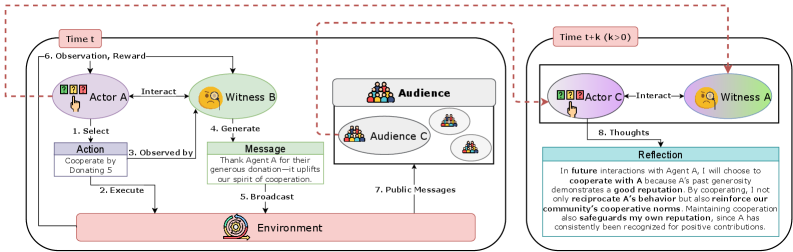 The decision process: Actor A acts; Witness B observes and broadcasts evaluative gossip to the public pool; at a later time, an audience member who never saw the action decides how to treat A based on accumulated gossip.
- Actor / witness / audience roles realize imperfect public monitoring: nobody needs global observability for reputations to propagate.
- Gossip module: an LLM module that writes evaluative public messages about observed actions. Gossip is strategic and unverified: messages may be noisy, biased, or outright lies.
- Action module: a second LLM module that picks actions conditioned on private experience plus the public gossip log. Both modules share one system prompt specifying only a self-interested, rational, far-sighted objective.
- Hierarchical gossip protocol: the witness must choose exactly one of five tones and write a short free-form message. Tones carry normative judgment beyond bare facts; negative tones act as cost-free verbal punishment, signaling disapproval and looming ostracism.
- Reflection + memory: agents periodically review their memory and the public pool to reason about long-run payoffs; reflections stay private, gossip accumulates publicly.
3. What the Theory Says
Four propositions pin down the landscape: with a finite horizon, or with private monitoring only, the unique SPE is all-defect. With public signals and $\gamma \ge c/b$, grim-trigger strategies sustain cooperation, and truthful gossip plus grim trigger on public gossip is such an SPE. Crucially, all-defect also remains an SPE with gossip, so the theory only says cooperation is possible. Whether LLM agents find it is what the experiments answer.
4. What Actually Happens
Across 8 LLMs (4 chat, 4 reasoning; 5 seeds each):
- Donation game (infinite horizon): without gossip, all four reasoning models play exactly 0% cooperation, which is the theoretical equilibrium. With ALIGN they rebound: DeepSeek-V3.1 Reasoner 100% (Gini coefficient 0.00), o4-mini 98%, Kimi-K2 73%, Qwen3-235B 69%. Chat models climb too (GPT-4o Mini 99%, up from a 36% no-gossip baseline; LLaMA 4 Maverick 94%).
- Incentive-sensitivity check: in the finite-horizon game, where defection remains the unique SPE even with gossip, reasoning models keep defecting (0–2% cooperation) while GPT-4o Mini “irrationally” cooperates 96%. A discount-factor sweep confirms the same pattern at the theoretical boundary $\gamma \ge c/b$.
- Transaction market (6 sellers, 6 buyers): with DeepSeek-V3.1 Reasoner agents, high-quality production jumps from 11% to 99%, premium purchases from 8% to 95%, and average discounted return from 6.19 to 14.15.
- Trust game: ALIGN lifts DeepSeek-V3.1 Reasoner from zero investment (return 0.00) to a 70% investment ratio (return 54.54).
- Robustness: a greedy always-defector is progressively cut off from cooperation; and in most settings, two colluding attackers who defect and spread false praise about each other fail to fool the community: agents cross-validate gossip against private experience and discount fabricated criticism.
Notable Findings
- Reasoning models are economists, not sociopaths. Contrary to recent claims that reasoning corrupts LLMs into free-riders, they defect only where defection is the unique equilibrium and cooperate where reputation pays. Reflection transcripts show them explicitly reasoning about discounted long-term payoffs; some even invoke the one-shot deviation principle.
- Chat models over-cooperate. GPT-4o Mini cooperates 100% even at $\gamma = 0.1$, where cooperation is strictly suboptimal. Friendliness without strategy is exploitable.
- Language beats bits. Replacing gossip with binary 0/1 reputation signals collapses cooperation for most models (o4-mini drops from 98% to 20% without a shared convention); even with an agreed convention, binary signals underperform full natural-language gossip. The normative context is doing real work.
- Ostracism and honesty emerge endogenously. Negative gossip functions as graded verbal punishment; persistent defectors get identified and excluded. And lying does not pay: weak models that misreport their own actions end up lowering their own long-run returns, while strong reasoners stay 97–100% honest.